
Asking YES/NO Questions in Italian
Now that you know how to make statements in Italian, how about asking questions? Luckily, some types of questions in Italian have a much simpler structure than English. For any questions that do not involve a question word, which in English are those WH-words – ‘who’, ‘what’, ‘where’, ‘when’, etc. – the sentence structure in Italian stays exactly the same between statements and questions.
In order to differentiate between a yes/no question and a simple statement in Italian, you simply use rising intonation as you would when asking a question in English.
STATEMENT – QUESTION
Mangi la carne ➙ Mangi la carne?
You eat meat ➙ Do you eat meat?
Vai al parco ➙ Vai al parco?
You’re going to the park ➙ Are you going to the park?
Parli italiano ➙ Parli italiano?
You speak Italian ➙ Do you speak Italian?
Vieni con noi ➙ Vieni con noi?
You're coming with us ➙ Are you coming with us?

Asking WH-Questions in Italian
When using question words, the structure can be a little different to English in some scenarios. Here are all the question words you will need in Italian:
- cosa / che / che cosa ➛ what
- chi ➛ who
- dove ➛ where
- quando ➛ when
- perché ➛ why
- come ➛ how
- quale ➛ which
When using question words to ask questions in Italian, the Subject always comes after the verb. This can be confusing for English speakers because we use the Auxiliary verbs ‘do’ and ’be’ to form questions with the Subject coming in between the Auxiliary and main verb (What do you want? When is the train arriving?). Therefore, the instinct for English speakers is to put the Subject before the verb when asking questions in Italian using question words.
However, if the Subject is not overtly mentioned, then the structure appears similar to English, but in a simpler form. In other words, if there is no Subject Pronoun, name or noun, then the word order appears to be the same as English, just using fewer words!
Che fai? What are you doing?
Dove vai? Whereare you going?
Perché non vogliono vivere in italia? Why don’t they want to live in Italy?
Come conosci Giada? How do you know Giada?
Quale pizza prendi? Which pizza are you having?

However when the Subject is overtly mentioned in the question, then it always follows the verb.
Dove va questo treno? Where does this train go?
Cosa vuole Marco? What does Mark want?
Quando parte l’aereo? When does the plane leave?
Quando arrivano Francesco e Michela? When do Francesco and Michela arrive?
When you want to ask a simple question using ESSERE (‘to be') as the main verb (e.g. What is this? Who is that?), then the structure is exactly the same as English. Easy!
Cos'è questo? What is this?
Chiè lei? Who is she?
Can't speak Italian yet?
It's not you.
It's the method.
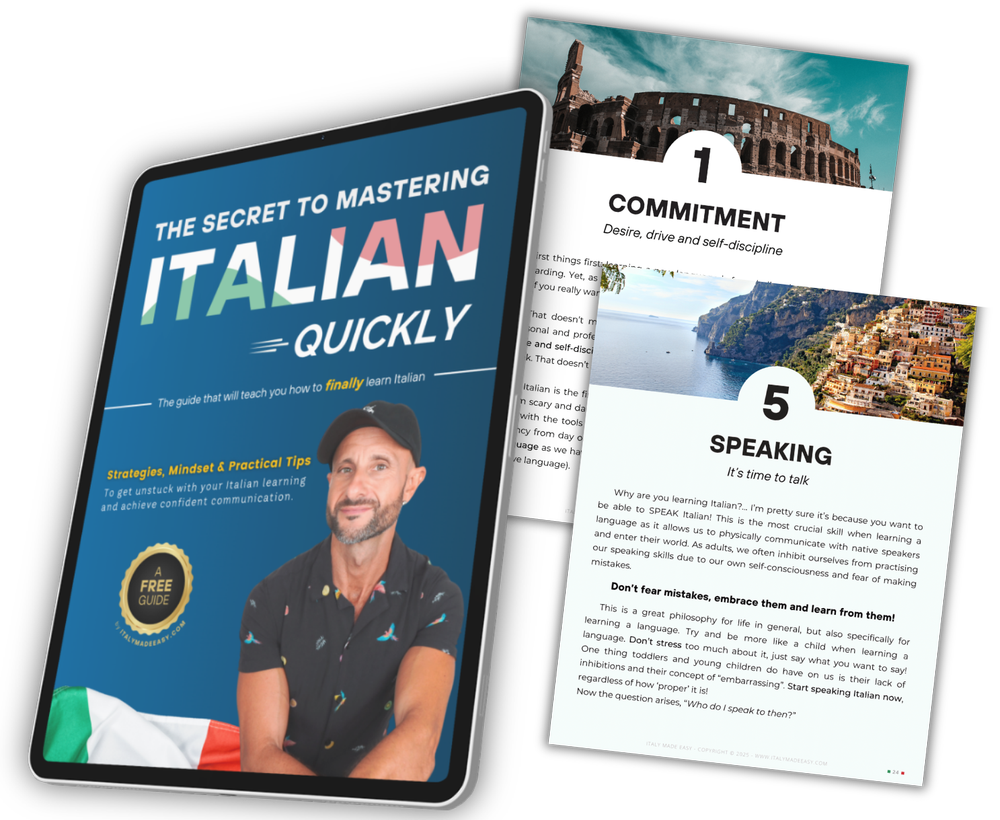
Download the free 39-page guide that reveals what's really holding you back, and the 7-pillar system that finally works.
Get My Free Guide →