
Analysis of the top competitors
Learning Italian has never been easier, but the “best” way to learn depends on why you want to speak this beautiful language. Your journey will look very different based on your personal goals. For example, if you are exploring your family roots to apply for Italian citizenship, you will need a solid program that covers formal grammar and official requirements. On the other hand, if you simply love Italian culture and want to enjoy classic movies or opera, you might prefer a method that focuses on stories and traditions. Even if you are just planning a dream trip to Rome or Florence, your main goal will be practicing real-life conversations rather than studying dusty textbooks.
In this article, we look at the many ways you can start learning today. We have reviewed 10 of the most popular tools available to help you find the one that fits your lifestyle. We will cover everything from fun mobile apps for a quick daily habit to professional, expert-led courses and private tutoring. By the end of this article, you’ll be able to move past “one-size-fits-all” lessons and build a simple, personal plan that actually gets you speaking Italian.
The 10 best competitors list:
- Duolingo
- Babbel
- Italy Made Easy
- Rosetta Stone
- Pimsleur
- iTalki
- Preply
- Mango Languages
- Rocket Languages
- FluentU
Quick Summary
- Best free app: Duolingo, Mango Languages (Free with library memberships)
- Best for structured learning: Babbel, Rocket Languages, Italy Made Easy
- Best for speaking practice: iTalki, Preply
- Best for audio learners: Pimsleur, FluentU
- Best for 1:1 tutoring: iTalki, Preply
- Best overall for serious learners: Italy Made Easy, Babbel

How we ranked these tools
To provide an objective overview, we evaluated each platform based on the following criteria:
- Speaking/listening realism: Does it prepare you for real, everyday life Italian conversations?
- Structure & progression: Is there a logical and gradual roadmap?
- Grammar clarity: Are the rules explained simply, or do they remain a mystery?
- Feedback/corrections: Does the app guide you when you make a mistake?
- Consistency/motivation: Does it keep you coming back, or will you forget it in a week?
- Value for money: Is the amount you learn worth the price you pay?
- Time-to-results for beginners: How quickly does the app empower you to handle basic interactions independently?
Comparison table
The 10 best tools:
1. Duolingo – Best for casual daily habit
Duolingo remains the most popular entry point for beginners due to its gamified interface and accessible free tier. It’s excellent for building a basic vocabulary base and staying motivated through daily streaks.
Pros:
- Completely free version available.
- Low pressure; great for building a consistent habit.
- Interactive UI that feels like a game.
Cons:
- Lacks deep grammar explanations for complex Italian structures.
- Not sufficient on its own to reach conversational fluency.
Best for you if: you have 5 minutes a day and want to learn basic vocabulary without spending money
Not ideal if: you need to understand why Italian grammar works the way it does.
2. Babbel – Best for practical and logical learning
Babbel is the ideal next step for those who want more substance, even if it means sacrificing the “game-like” feel. It focuses on real-life situations and explains the logic behind the language, making it one of the most balanced tools for those seeking a structured method without the commitment of an academic course.
Pros:
- Lessons are built around useful dialogues (ordering at a restaurant, checking into a hotel, talking about work).
- It provides short but effective grammar explanations integrated directly into the exercises.
- The speech recognition system helps you refine your pronunciation in an intuitive way.
Cons:
- There is no complete free version; it requires a monthly or annual subscription.
- Since it is less gamified than Duolingo, it requires more self-discipline to maintain consistency.
Best for you if: you want to understand the “why” behind the rules and need to use the language for travel or work in a short amount of time
Not ideal if: you are looking for a completely free app or if you find traditional, structured lessons boring.
3. Italy Made Easy – Best for deep, in-depth mastery
Italy Made Easy isn’t just a simple app; it’s a comprehensive digital Platform designed for those who want to stop “playing” with the language and start speaking it seriously. Founded by linguist and polyglot Manu Venditti, a native Italian speaker, the method is based on explaining Italian using the logic of the English-speaking brain, thereby eliminating the guesswork associated with grammar.
Pros:
- Complete roadmap: It offers a structured path (from Beginner to Mastery) that leaves zero gaps in your knowledge – perfect for those seeking in-depth instruction.
- Deep logical explanations: Manu explains the “why” behind every rule, making even complex concepts like the subjunctive or reflexive verbs feel intuitive.
- High commitment required: This program demands active study sessions; it is not meant for passive, casual scrolling.
- Higher investment: Since it is a professional-grade program with human support, the cost is higher than standard commercial apps (available via monthly or annual subscriptions).
Best for you if: you are moving to Italy, have Italian family, or simply want to reach total fluency while understanding every cultural and logical nuance of the language.
Not ideal if: you are just looking for a quick game to pick up a few words before a three-day vacation, or if you aren’t ready to dedicate at least 20–30 minutes per session to serious study.
4. Rosetta Stone – Best for Visual Immersion
Rosetta Stone is the pioneer of the “Dynamic Immersion” method, designed to mimic how we learned our first language as children. Unlike most other tools, it completely removes translations and grammar explanations, forcing you to intuit the meaning of words and phrases by connecting native audio directly to high-quality imagery.
Pros:
- By eliminating your native language entirely, it trains your brain to stop “translating in your head” and start thinking directly in the target language.
- Its proprietary TruAccent® speech recognition engine is widely considered one of the most accurate in the industry for refining your accent.
- The interface is elegant and distraction-free, providing a Zen-like learning environment that focuses strictly on visual and auditory association.
Cons:
- Because there are no explicit explanations, complex grammatical structures can become confusing or frustrating to figure out on your own.
- While excellent for pronunciation drills, the platform lacks integrated features for spontaneous conversation or real-time verbal interaction.
Best for you if: you are a visual learner who dislikes traditional grammar study and wants an intuitive, immersive environment to build a foundation.
Not ideal if: you need to understand the “rules” of the language or if you want to be able to have complex conversations in a short period of time.
5. Pimsleur – Best for Audio Learners
Pimsleur is a legendary audio-based program built on the “Pimsleur Method“, which focuses on organic learning through listening and speaking. It is designed to be used completely hands-free, making it the gold standard for learners who want to improve their verbal skills and pronunciation during their commute or while doing chores.
Pros:
- Instead of passive listening, the program constantly prompts you to recall and say phrases aloud, which builds strong muscle memory for speech.
- It breaks down words into individual sounds and syllables from back-to-front, helping you master difficult accents with high accuracy.
- Since the core lessons are 30-minute audio sessions, you can learn while driving, walking, or working out without needing to look at a screen.
Cons:
- Compared to other tools, Pimsleur covers a smaller range of words, focusing more on the core structures of the language rather than a vast lexicon.
- While it forces you to speak to the app, it does not provide live conversation with humans, so you’ll eventually need a tutor to practice spontaneous dialogue.
Best for you if: you are a busy person who learns best through listening and wants to sound like a native speaker from day one.
Not ideal if: you are a visual learner who needs to see words written down or if you want to master reading and writing quickly.
6. iTalki – Best for Human Interaction
Italki is the world’s largest marketplace for language 1:1 tutoring. Unlike software-based apps, iTalki connects you directly with native speakers and professional teachers, allowing for a completely personalized experience that focuses on real conversation and cultural nuances.
Pros:
- You choose your teacher based on your goals, budget, and even specific regional accents. Whether you need exam prep or just casual chat, the lesson is 100% about you.
- With a “pay-per-lesson” model and no monthly subscriptions, you have full control over your spending. You can book 30, 45, 60, or 90-minute sessions whenever it fits your schedule.
- With over 30,000 teachers covering 150+ languages, you can find a tutor for almost any dialect or niche interest, from business Italian to regional slang.
Cons:
- The sheer volume of tutors can be overwhelming, and it may take a few “trial lessons” and extra money to find the teacher that best fits your learning style.
- Since it is a marketplace, there is no standardized path. Your progress depends entirely on your teacher’s methods or your own ability to direct your learning.
Best for you if: you want to overcome the fear of speaking, need personalized feedback, and prefer a flexible schedule without being tied to a subscription.
Not ideal if: you prefer a self-paced, gamified experience or if you feel uncomfortable with 1:1 social interaction in the early stages of learning.
7. Preply – Best for Structured Tutoring
Preply offers a highly polished platform for 1:1 language lessons. While it also connects you with native tutors, Preply distinguishes itself by providing integrated learning materials and a subscription model designed to keep students committed to a regular study routine.
Pros:
- Unlike other marketplaces, Preply offers its own “Academy” with structured curricula and progress tracking that tutors can use during your lessons.
- The platform includes built-in tools like a vocabulary bank that automatically saves new words discussed during your call for later review.
- The custom-built video classroom is excellent, featuring integrated chat, whiteboard, and file-sharing tools that make the learning experience very smooth.
Cons:
- Preply requires you to commit to a set number of hours per week/month. If you don’t use your hours within the billing cycle, you risk losing them, which can be stressful for busy learners.
- While it has great lesson support, it is not a standalone “app” you can use for 5 minutes of solo study; it is entirely dependent on your scheduled appointments.
Best for you if: you want the human touch of a tutor but prefer a more “school-like” structure with a set schedule and clear curriculum.
Not ideal if: your schedule is unpredictable and you need a flexible “pay-as-you-go” system without recurring monthly charges.
8. Mango Languages – Best for Practical Conversation & Cultural Context
Mango Languages is a sleek, user-friendly platform that focuses on “Intuitive Language Construction“. It is designed to help you start speaking immediately by breaking down real-life conversations into color-coded “building blocks“, making it one of the most accessible tools for beginners who want to see how a language is logically put together.
Pros:
- It uses a unique color-coding system to show how words in English map to the target language, helping you intuitively understand sentence structure and word order.
- As you move through lessons, small “lightbulb” icons provide essential cultural etiquette and bite-sized grammar rules exactly when you need them.
- Every phrase is recorded by professional native voice actors, allowing you to hear the natural rhythm and melody of the language at both normal and slow speeds.
Cons:
- The structure is very consistent across all units, which can feel monotonous or “dry” for learners who prefer the variety and games found in apps like Duolingo.
- While it features a “voice comparison” tool to check your pronunciation against a native speaker, it does not offer real-time conversation or live feedback from a human tutor.
Best for you if: you want a logical, clear-cut way to learn practical phrases for travel and you enjoy seeing exactly how a sentence is built. (P.S. Check your local library – many offer Mango for free!).
Not ideal if: you are an advanced learner looking for deep immersion or if you need a high-energy, gamified environment to stay motivated.
9. Rocket Languages – Best for Comprehensive, Structured Learning
Rocket Languages is a “powerhouse” program that bridges the gap between casual apps and formal classroom settings. It is built on a massive amount of content – combining interactive audio, detailed grammar lessons, and cultural insights – making it one of the most complete self-paced courses on the market in 2026.
Pros:
- It covers all four pillars of language learning (speaking, listening, reading, and writing) plus deep cultural context, which many apps overlook.
- The “Interactive Audio” lessons work like a podcast where you are an active participant, making it great for building conversational confidence.
- Unlike most modern apps that require a subscription, Rocket offers a “Lifetime Access” model. You pay once and own the course (and its updates) forever.
Cons:
- The platform is incredibly deep but less “flashy” or gamified than Duolingo. It feels more like a digital textbook and audio course than a game.
- While the voice recognition is top-tier for pronunciation, the platform lacks live 1:1 interaction with a human teacher.
Best for you if: you want a “one-stop shop” that takes you from zero to an advanced level and you prefer owning your materials rather than paying every month.
Not ideal if: you are a casual learner who needs games and streaks to stay motivated, or if you only have 5 minutes a day to spare.
10. FluentU – Best for Video-Based Immersion
FluentU takes a unique approach by turning real-world videos – like movie trailers, music videos, news, and inspiring talks – into personalized language learning lessons. It is designed for learners who find textbooks boring and want to see how the language is actually used by native speakers in pop culture and media.
Pros:
- Instead of scripted dialogues, you learn from real YouTube and Netflix content, exposing you to natural speed, slang, and cultural context.
- Every word in the subtitles is clickable. Hovering over a word instantly pauses the video to show you a definition, image, and example sentences.
- After watching a video, the app generates quizzes based on the specific vocabulary you just heard, helping to reinforce what you’ve learned through spaced repetition.
Cons:
- The platform focuses heavily on vocabulary and immersion; it does not offer structured lessons or deep explanations of complex grammatical rules.
- While it has a “speak this” feature in some quizzes, the platform lacks integrated live conversation or sophisticated feedback on your verbal output.
Best for you if: you are a visual learner who loves media and wants to bridge the gap between “classroom Italian” and “real-world Italian“.
Not ideal if: you are an absolute beginner who needs a structured curriculum or if you prefer a one-time purchase over a high monthly fee.

What to choose based on your goal (decision tree):
Choosing the right tool isn’t about finding the “best” app in absolute terms, but about finding the one that aligns with your specific goals. Every learner has a different priority: some need to survive a 2-week trip to Italy, others want to achieve fluency, and some just want to keep their brain active for 5 minutes a day.
The “perfect” method only exists when the tool’s strength matches your personal objective. To help you navigate the crowded landscape, we’ve categorized the top performers based on the results they actually deliver.
If you want to speak ASAP…
Go with Pimsleur to build muscle memory and confidence immediately, or Babbel for practical, real-world dialogues that you can use on your next trip.
If you only have 5–10 minutes/day…
Stick with Duolingo to keep your streak alive and build basic vocabulary, or Mango Languages for a quick, logical breakdown of how sentences are built.
If you need structure from zero…
Choose Rocket Languages if you want a comprehensive, self-paced “all-in-one” course, or Italy Made Easy if you want deep, in-depth video lessons that explain the “why” behind every rule.
If you want 1:1 feedback…
Head to italki if you want total flexibility and a “pay-as-you-go” model, or Preply if you prefer a more structured tutoring experience with a consistent weekly schedule.
If you learn best with audio…
Pimsleur is the undisputed king for hands-free learning, but Rocket Languages is also an excellent choice for its interactive podcast-style lessons.
If you want immersive video content…
Use FluentU to learn from movie trailers and music videos, or Italy Made Easy for high-quality, teacher-led video explanations that feel like a real classroom.
If you are a visual learner who hates grammar…
Rosetta Stone is your best bet to learn through pure image-to-word association without any translations.
Can you combine tools?
While you can certainly make progress with a single app, many learners eventually hit a plateau where one tool’s limitations become frustrating. To truly unlock the language without settling for just “getting by“, the most effective strategy is creating a “Learning Stack“. By pairing tools that serve different purposes, you fill the gaps that a single platform might leave behind – turning a linear learning process into a multi-dimensional experience. Here are three recommended “Combo Packs” for those who want to take their Italian to the next level.
1. The “Pro Fluency” Stack (App + Tutor)
This is the gold standard for serious learners. You use a structured course to understand the “how” and “why“, and a tutor to turn that knowledge into real-time conversation.
- The Combo:Italy Made Easy + italki
Use Italy Made Easy as your primary “brain“. Watch the deep-dive video lessons to master complex grammar and syntax. Then, book one or two sessions a week on iTalki specifically to practice the concepts you just learned. It prevents the “passive learning” trap. You aren’t just watching videos; you are immediately held accountable by a human being.
2. The “Busy Professional” Stack (Audio + Guided Course)
Ideal for those who spend a lot of time commuting or multi-tasking, but still want a solid foundation in reading and writing.
- The Combo:Pimsleur + Babbel
Listen to Pimsleur during your commute or while exercising to master your accent and verbal reflexes hands-free. In the evening, spend 10–15 minutes on Babbel to see those same words written down and to reinforce the grammar rules behind them. It attacks the language through two different senses (auditory and visual), doubling your retention rate.
3. The “Immersion & Habit” Stack (Spaced Repetition + Course)
Perfect for intermediate learners who want to stop translating in their head and start “living” in Italian.
- The Combo:FluentU + Duolingo
Use FluentU as your primary source of input – watching real-world videos to absorb slang and natural speed. Use Duolingo as your “daily anchor” to keep your vocabulary fresh and ensure you never skip a day of practice, even when you’re tired. FluentU provides the high-level context, while Duolingo provides the low-pressure repetition needed to make basic vocabulary permanent.

Frequently Asked Questions
What is the best tool to learn Italian as a beginner?
Choosing the right tool as a beginner depends entirely on whether you are looking for a quick introduction or a path to mastery. For those who want a truly comprehensive journey, Italy Made Easy stands out because it is designed to accompany beginners from their very first “ciao” all the way to high-level fluency through a deeply structured and guided learning path. Unlike many standalone apps that can feel less structured or scattered, this platform functions as a full language academy where a professional linguist explains the logic of the language. If your goal is real conversation, you’ll usually need this kind of structured guidance and feedback, not just drills, to move beyond basic memorization. On the other hand, Babbel is often best for casual practice if you need to learn functional, real-world phrases for a trip in a short amount of time. Rocket Languages offers a similar all-in-one approach but feels more like a digital textbook combined with interactive audio, making it a great “all-rounder” for those who want to own their materials forever. The key difference lies in the depth of the commitment: while Babbel and Rocket Languages are excellent for building an initial vocabulary, Italy Made Easy focuses on teaching you how to “think” in Italian, ensuring you don’t hit a plateau once you move past the beginner stage.
Can I become fluent in Italian with Duolingo alone?
While Duolingo is an excellent resource and best for casual practice, relying solely on it to reach fluency is generally difficult due to its heavy focus on gamification. The system is designed more like a game than an academic path, which makes it perfect for maintaining a daily habit and learning individual vocabulary words, but it often remains less structured regarding a deep understanding of grammar. If your goal is real conversation, you’ll usually need structured guidance and feedback, not just drills, as the repetitive approach typical of these platforms remains limited for speaking. Ultimately, Duolingo is a fantastic tool for building initial vocabulary in a fun way, but to avoid settling for a superficial level, it is best used as a “daily anchor” within a broader study plan that includes logical grammar explanations and human interaction.
How long does it take to learn Italian to conversational level?
The timeline for reaching a conversational level in Italian is a common question, but the truth is that a “standard” answer is hard to provide because the process is deeply personal and depends on a multitude of factors. Learning a language is less like a sprint and more like a long-distance journey, often filled with peaks of rapid progress and plateaus where you might feel stuck; it’s a path shaped by your unique goals and the time you can realistically dedicate each day. While some might reach a functional level in 4 to 6 months by immersing themselves for hours, others might take a year or more of consistent, slower-paced study to reach the same milestone.
A major variable in this journey is the specific tool you choose to guide you. For example, relying on an app that is best for casual practice might help you pick up travel phrases quickly, but it can be less structured for long-term retention of complex sentence building. If your goal is real conversation, you’ll usually need structured guidance and feedback, not just drills, to navigate the natural “highs and lows” of the learning process.
What’s better: apps or private tutoring?
When deciding between language apps and private tutoring, the answer isn’t about which is objectively “better“, but rather which role each plays in a well-rounded learning strategy. Apps like Babbel or Duolingo are often best for casual practice because they offer unmatched convenience and a low-pressure environment to build a core vocabulary. Due to reliance on algorithms, they are less capable of spontaneous interaction and often struggle with natural conversation flow. They provide the “building blocks” – words and grammar – but rarely teach how to use them in real-time discussions.
On the other hand, private tutoring through platforms like iTalki or Preply is superior for providing the personalized feedback and cultural nuance that an algorithm simply cannot replicate. If your goal is real conversation, you’ll usually need structured guidance and feedback, not just drills, to overcome the plateau of mid-level fluency. A tutor can pinpoint your phonetic errors and encourage you to apply learned grammar creatively. Ultimately, the most effective approach is a hybrid one: use a comprehensive tool like Italy Made Easy or Rocket Languages to build your technical foundation, and then use a private tutor to “activate” that knowledge through live practice.
What’s the best tool for Italian speaking practice?
For real human interaction, italki is the gold standard because its “pay-per-lesson” model offers the most flexibility and is often the most budget-friendly way to find native tutors. While Preply offers a similar experience, it typically requires a monthly subscription commitment, making it better for those who want a forced routine but less convenient for those on a tight or unpredictable budget. If you aren’t ready for a live person yet, Pimsleur is the best audio-based tool to develop your “speaking muscles” at a low fixed monthly cost, though it remains limited for speaking since it lacks spontaneous, two-way dialogue. For real conversation, you need structured guidance and feedback from a tutor on platforms like italki, not just drills, to build your own thoughts.
What’s the best Italian course for grammar explanations?
If you are looking for a course that truly prioritizes the “why” behind the language, Italy Made Easy is the definitive choice for those who want a deep, professional foundation. Unlike many platforms that offer only surface-level tips, this program is a full-scale academy designed by a professional linguist to take you from absolute zero to high-level fluency. It stands out because it doesn’t just give you phrases to memorize; it teaches you how to “think” in Italian, making it ideal for serious learners who want to move past the beginner stage without hitting a wall.
In contrast, Rocket Languages and Babbel offer different approaches to grammar. Rocket Languages acts more like a comprehensive digital textbook, providing a very structured, linear path with clear explanations, which is great for those who prefer a traditional, all-in-one resource. Babbel, on the other hand, is best for casual practice because it weaves grammar into short, 15-minute lessons focused on practical, real-world situations. Both can feel less structured than Italy Made Easy’s deep-dive learning path and are limited for sophisticated speaking due to their automated nature. If your goal is real conversation and a native-like grasp of the rules, you’ll usually need the kind of structured guidance and expert feedback found in Italy Made Easy, rather than the more simplified drills provided by typical mobile-first apps.
Are free Italian apps actually effective?
Free apps like Duolingo or Mango Languages (which is often free through local libraries) are highly effective as a “daily anchor” for building a consistent habit and learning core vocabulary without a financial commitment. They are often best for casual practice, providing a low-pressure environment that keeps the language fresh in your mind through gamification. These platforms rely on algorithms and pre-set drills, which can make them less effective at explaining complex grammar nuances and limit natural, spontaneous speaking.
For real conversation in Italian, structured guidance and feedback are necessary, not just drills, to express your thoughts. Free apps often lead to a plateau for learners due to insufficient feedback on pronunciation and sentence structure. To avoid settling for a superficial level, the most effective strategy is to use free apps for daily engagement while supplementing them with more robust, guided courses.
Is it worth paying for Babbel/Rosetta Stone/Pimsleur?
Paying for these tools is worth it for a structured environment and better audio than free apps. However, you must be fully aware of their specific limits: Babbel and Rosetta Stone can still feel less structured for those who need deep grammatical context, as they often rely on repetitive patterns or “guessing” through images. Similarly, while Pimsleur is excellent for pronunciation, it is limited for speaking in a spontaneous, unscripted way because it lacks real human interaction.
Meaningful conversation requires structured guidance and constructive feedback instead of just drills to prevent plateauing in language use. For this reason, many learners eventually find it more effective to transition to a more structured and guided program.
How much should I study Italian per day?
The amount of time you should study depends entirely on your personal schedule and goals, but the real beauty of online learning is the total flexibility it offers. Unlike traditional in-person classes, using apps or guided digital courses allows you to manage your time exactly as you prefer; some days you might have an hour for a deep dive, while others you may only have 10 minutes for a quick review. While a consistent daily contribution is always the most effective way to accelerate your progress, the ability to adapt your study sessions to your own needs is the biggest “pro” of the digital path.
What’s the best way to learn Italian for travel?
Learning Italian before a trip is essential because it allows you to immerse yourself in the culture and experience the country at a much deeper level. While apps best for casual practice can provide a basic vocabulary for survival, they often leave you limited for speaking when it comes to meaningful interactions. To truly live the Italian experience and connect with locals, it is better to choose a more structured course, which provides the solid foundation and cultural context needed to move beyond simple memorization.

Conclusion
Choosing the right path is about matching your tool to your lifestyle:
- Choose iTalki if you want 1-on-1 human interaction immediately.
- Choose Pimsleur if you spend a lot of time commuting and prefer audio-only.
- Choose Babbel for a balanced, app-based curriculum.
If you are tired of jumping between apps and want a professional, structured environment that guarantees you will actually speak the language, try Italy Made Easy. It’s the closest thing to having a private language academy in your living room.
Choose Italy Made Easy if:
- You want a structured course that guides you step by step to fluency.
- You want effective grammar explanations that teach you how to think in Italian.
- You want support in your language studies.
Ready to get serious about Italian? If you want a clear roadmap and professional results, join Italy Made Easy today and build the foundation you’ve always wanted.
Can't speak Italian yet?
It's not you.
It's the method.
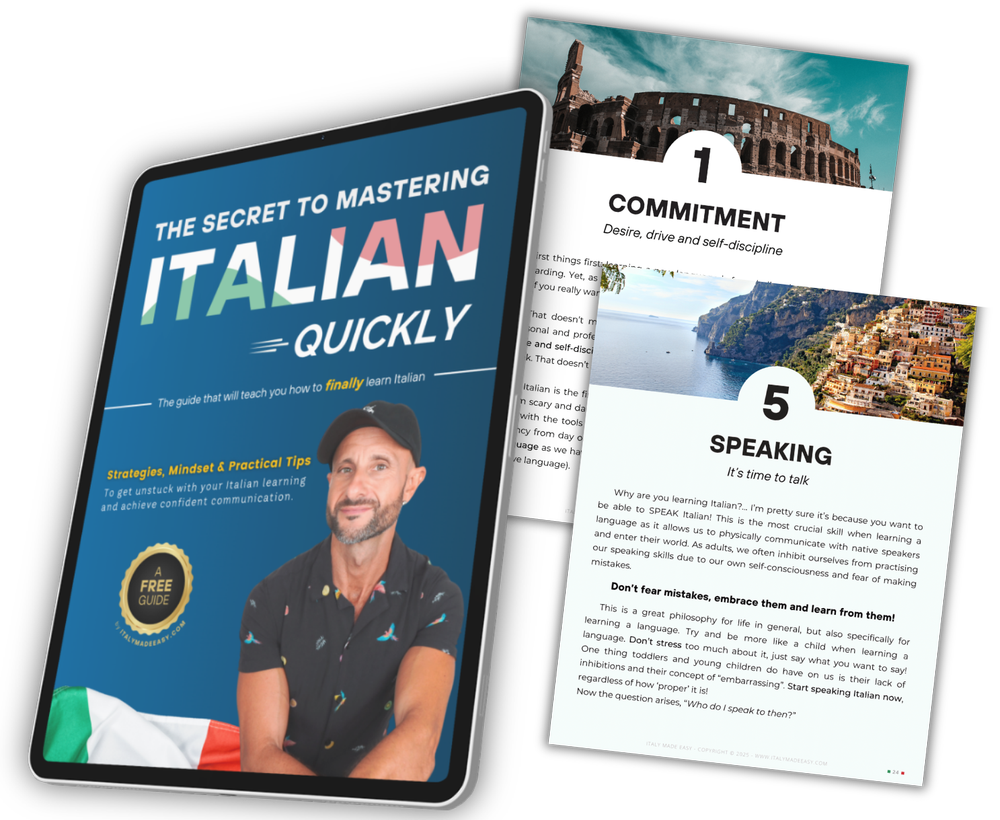
Download the free 39-page guide that reveals what's really holding you back, and the 7-pillar system that finally works.
Get My Free Guide →