
Italy Made Easy vs. Duolingo: What is the Best Way to Learn Italian?
Are you dreaming of speaking Italian but feeling a bit overwhelmed by all the options? You might be asking yourself: “Should I go with Duolingo, Babbel, Rosetta Stone, or is Italy Made Easy the right fit for me?“ Don't worry – you’re not alone! With so many apps and courses out there, it’s hard to know which one will actually help you hold a real conversation and which one is just a fun game for your phone. Whether you are a total beginner or looking to finally reach fluency, this article is here to help. We’ve done the heavy lifting for you, comparing the best tools available in 2026 to make your choice simple, clear, and maybe even a little bit fun.
Quick Summary
- Choose Duolingo if: You are looking for a 100% free and casual way to pick up basic vocabulary through gaming, without any pressure.
- Choose Babbel if: You prefer a more structured app with realistic dialogues and straightforward grammar explanations for everyday use.
- Choose Rosetta Stone if: You enjoy a “full immersion” approach based exclusively on images and sounds, without any translations in your native language.
- Choose Italy Made Easy if: You want to truly understand the logic of the language, speak with confidence, and follow a complete learning path created by experts.
- The Main Difference: Apps based on repetition and gamification (Duolingo/Babbel/Rosetta Stone) versus a deep, guided educational system with human support (Italy Made Easy).
- Mini-Verdict: If your goal is real fluency and you don't want to just guess the rules but actually master them, Italy Made Easy is the best choice for you.
At a Glance: Key Differences
Who is Duolingo Ideal For?
- Anyone who wants to spend $0 and has no specific deadline for results.
- People who enjoy “streaks” and competitive leaderboards to stay motivated.
- Absolute beginners who just want to see if they like the sound of the Italian language.
- Users who only have 2 to 5 minutes of free time per day.
Who is Duolingo Ideal For?
- Practical learners who want to learn useful phrases for travel or daily life.
- People who prefer structure over games but aren't ready for a full-scale academic course.
- Students who like clear grammar tips delivered in short, manageable chunks that fit into a 15-minute break.
- Learners on a budget who are willing to pay a small monthly fee for a more professional experience than a free app.
Who is Rosetta Stone Ideal For?
- Visual and intuitive learners who prefer to learn through pictures and patterns rather than translations and explanations.
- Users focusing on pronunciation, as the “TruAccent” technology is one of the best for fine-tuning your Italian accent.
- People who want “Full Immersion” and don't want to hear or see any English during their study sessions.
- Long-term hobbyists who can take advantage of the “Lifetime” deal to learn Italian (and other languages) at their own pace.
Who is Italy Made Easy Ideal For?
- Learners who are frustrated with apps and want to know why the grammar works.
- People who need to speak Italian for family, work, or moving to Italy.
- Those who value a human touch, video lessons, and a vibrant community of students.
- Beginners who want a “Zero to Fluency” roadmap without the guesswork of random vocabulary.

To help you choose the right tool for your journey, we have broken down the core features of these platforms into five key categories. This comparison highlights the practical differences between “playing with an app” and “mastering a language” with a professional method. Discover what each feature actually offers and, more importantly, what it means for your personal progress.
Content and Levels
- Duolingo: Offers an endless path of “gamified” units. While it covers thousands of words, the progression is often slow and repetitive.
- Babbel: Provides structured courses (A1 to B2) centered around practical themes like travel and work.
- Rosetta Stone: Uses a “Dynamic Immersion” method with images and sounds across 20+ units.
- Italy Made Easy: Provides a structured learning path (from Zero to Advanced) with deep-dive video lessons that ensure you master the language structure.
What this means for you: Instead of playing games that lead to a plateau, with Italy Made Easy you follow a professional curriculum that takes you from “knowing words” to “mastering the language” with a clear sense of progress.
Speaking and Listening Practice
- Duolingo: Primarily focused on “shadowing” (repeating what you hear) with limited AI interaction unless you pay for the Max plan.
- Babbel: Features high-quality audio from native speakers, but real-time speaking requires an extra Babbel Live subscription.
- Rosetta Stone: Uses TruAccent technology to polish your pronunciation to match a native model.
- Italy Made Easy: Focuses on Immersive videos that train your brain to build original thoughts and to get the most of the Italian language.
What this means for you: You won't just be a “parrot” repeating phrases; with Italy Made Easy you will develop the actual muscle memory and confidence needed to handle real-life conversations without a script.
Grammar Explanations
- Duolingo: Grammar is almost hidden. You are expected to learn through trial and error, which can be frustrating.
- Babbel: Offers short, “bite-sized” grammar pop-ups that explain the basics simply.
- Rosetta Stone:Zero explicit grammar. It relies entirely on your ability to spot patterns through immersion.
- Italy Made Easy: The core strength of the program. It provides comprehensive video explanations in English that demystify Italian logic.
What this means for you: With Italy Made Easy you stop guessing and start understanding. By knowing the “why” behind the rules, you save significant time and confusion and can build any sentence you want.
Personalization and Study Path
- Duolingo: Uses an algorithm-driven path that is rigid and the same for every user.
- Babbel: Allows some freedom to choose between specific modules like “Business” or “Travel“.
- Rosetta Stone: Offers a very linear immersion structure that you must follow in a specific sequence.
- Italy Made Easy: Provides a flexible journey that empowers you to learn at your own pace while following a proven roadmap.
What this means for you: With Italy Made Easy you are in control of your education. You get a comprehensive structure that adapts to your life, allowing you to focus on what actually matters for your specific goals (family, work, or travel).
Feedback and Corrections
- Duolingo: Uses a “Heart System” that penalizes mistakes. Feedback is binary (Right/Wrong) with very little context.
- Babbel: Corrects your spelling and grammar instantly within the exercises using an automated system.
- Rosetta Stone: Focuses almost exclusively on phonetic feedback to ensure your accent is correct.
- Italy Made Easy: Offers a Human-Centric approach with access to expert tutors and a community for nuanced answers.
What this means for you: With Italy Made Easy you don't just get a “red X” when you're wrong. You get explanations and human support that help you fix bad habits before they become permanent, ensuring you speak natural Italian.
Pricing and Value Comparison
To help you understand exactly what you are paying for, we have compared the financial commitment of each platform against the real-world results they deliver. This breakdown highlights the difference between a low-cost monthly subscription and a long-term investment in your fluency.
Duolingo: The “Freemium” Game
- Plans: Free (with ads and 5-heart limit), Super ($12.99/mo, or Max ($29.99/mo) for AI features.
- Value for Beginners: Good for testing the “sound” of Italian for $0, but progress is slow. You pay with your time and constant ad interruptions.
- The Reality: To get any actual speaking practice (AI Video Calls), you must commit to the most expensive tier ($168/year).
Babbel: The Subscription Model
- Plans: App-only (~$7.99, ~$11.99 or ~$15.99/mo or Lifetime ~$299.99)
- Value for Beginners: Affordable entry point for basic grammar, but “Real Human” interaction requires a significant monthly upcharge.
- The Reality: The base app is a polished digital workbook; it doesn't offer a comprehensive mentorship experience.
Rosetta Stone: The Lifetime Investment
- Plans: Subscription (~$11 to $16/mo) or Lifetime Unlimited ($399)
- Value for Beginners: Great for those who want a one-time payment to practice pronunciation across multiple languages over several years.
- The Reality: High value for accent training, but low value for anyone needing to understand why Italian grammar works.
Italy Made Easy: The Academic Investment
- Plans: Monthly ($80 USD), Annual ($480 USD). All plans grant full access to all courses and premium content.
- Value for Beginners: You get a complete “Zero to Fluency” system. Every dollar goes toward extensive expert video instruction per level, not just “clicking buttons“.
- The Reality: While the upfront cost is higher than a monthly app, the cost per hour of expert instruction is significantly lower than private tutoring or structured courses.
Learning Experience and Results
A Typical Lesson
- Duolingo: A 2–5 minute “sprint” of gamified exercises like translating sentences, matching pairs, and reordering words. It feels like a quick mobile game, often focusing on repetitive vocabulary drills.
- Babbel: A 10–15 minute session focused on a specific real-life scenario (e.g., ordering coffee). It blends dialogue practice, grammar tips, and speech recognition in a structured, digital workbook format.
- Rosetta Stone: A fully immersive, image-based lesson where you match spoken Italian words to photos. There are no English explanations, forcing you to “guess” the meaning through visual patterns and intuition.
- Italy Made Easy: A comprehensive video-led masterclass. You watch a detailed explanation by an expert instructor (Manu), followed by active production assignments and immersion tasks designed to build deep understanding.
What this means for you: Instead of just “tapping” on a screen, with Italy Made Easy you are actually “studying“. With Italy Made Easy, a total beginner understands the logic of a sentence after one lesson, whereas on Duolingo, you might just memorize the sentence without knowing how to change it.
Path and Guidance
- Duolingo: Uses a rigid, algorithm-driven path. You must complete “Level A” to unlock “Level B“, with very little room to skip ahead or customize based on your specific needs.
- Babbel & Rosetta Stone: Offer a clear linear progression (A1-B2). Babbel allows you to choose specific “modules” (Travel, Business), while Rosetta Stone follows a fixed sequence of units.
- Italy Made Easy: Provides a structured roadmap from Zero to Pro. It’s a guided mentorship where you always know exactly what to study next to reach the next fluency milestone.
What this means for you: With Italy Made Easy you never feel lost. While apps leave you “pokingaround” for the next lesson, Italy Made Easy provides a comprehensive learning path that guides you step-by-step toward your goals.
Time to Conversation
- Duolingo: After months, you will know many words, but most users struggle to hold a 30-second spontaneous conversation because they lack sentence-building skills.
- Babbel & Rosetta Stone: You can typically handle basic “tourist” interactions after 3–6 months of consistent daily use.
- Italy Made Easy: People often reach basic conversational confidence in under 4 months. By focusing on “thinking in Italian” from day one, you skip the “mental translation” phase that slows down app users.
What this means for you: If your goal is to speak with family or locals in Italy, Italy Made Easy is the fastest route. It’s designed for those who don’t want to be “forever beginners” and actually need to use the language.
Motivation and Engagement
- Duolingo: Uses high-pressure “streaks“, leaderboards, and push notifications. It’s great for building a daily habit, but the motivation is often about “not losing your streak” rather than “learning the language”.
- Babbel & Rosetta Stone: Rely on your personal discipline and interest in the content. Babbel offers podcasts and daily goals to keep you coming back.
- Italy Made Easy: Motivation comes from real progress and community. Seeing yourself understand a complex video and interacting with a vibrant social network of fellow students provides a much deeper sense of achievement than a digital trophy.
What this means for you: If you want to stop “playing” with Italian and start “living” it, the structured support and community at Italy Made Easy will keep you inspired long after the novelty of an app wears off.
To give you a balanced perspective, we have outlined the core strengths and limitations of each platform. This breakdown highlights where each app shines and where it might fall short, helping you decide which tool aligns best with your personal learning style and ultimate fluency goals.

Duolingo
Pros
- Completely Free: The best entry point for anyone wanting to explore Italian without financial commitment.
- Highly Gamified: The “streak” system and leaderboards are excellent for building a daily habit.
- Low Pressure: Ideal for casual learners who only have 2–5 minutes a day.
- Visual Interface: Bright, engaging, and very easy for children or absolute beginners to navigate.
Cons
- Hidden Grammar: You often learn “what” to say but never “why“, leading to confusion with complex Italian tenses.
- Repetitive Content: Can feel like a “chore” after a while, with little progress toward actual conversation.
- Lack of Human Nuance: The AI doesn't always recognize natural variations in speech or synonyms.
Babbel
Pros
- Practical Focus: Lessons are designed around real-life situations like traveling or ordering food.
- High-Quality Audio: Uses recordings from native speakers rather than purely robotic voices.
- Structured Path: Clearly defined levels (A1-B2) that feel more like a digital textbook than a game.
Cons
- Can Be Dry: The “fill-in-the-blank” style can feel monotonous compared to more interactive methods.
- No Live Interaction: The standard app lacks real-time feedback from teachers.
- Limited for Advanced Learners: Once you reach an intermediate level, the content tends to plateau.
Rosetta Stone
Pros
- Full Immersion: Forces you to think in Italian from day one by removing English translations.
- TruAccent Technology: One of the best tools on the market for fine-tuning your pronunciation.
- Polished Experience: A clean, professional interface that has been refined over 25+ years.
Cons
- Frustrating for Some: The “no-explanation” approach can leave you guessing for hours about simple grammar rules.
- Lacks Cultural Context: Because the images are used for multiple languages, they don't always reflect Italian culture or slang.
- Rigid Progression: Very difficult to jump around or focus on a specific area you might need for a trip.
Italy Made Easy
Pros
- Expert Mentorship: You aren't just using an app; you are being taught by a native expert who explains the “logic” of Italian in English.
- Zero Guesswork: Provides a comprehensive “Zero to Fluency” roadmap with a series of videos per level.
- Active Production: Focuses on training you to build your own sentences, not just repeating what you hear.
- Community Support: Access to a vibrant student network and expert tutors to answer your specific questions.
Cons
- Higher Upfront Cost: As a professional academy, it requires a larger investment than a casual monthly app.
- Time Intensive: Not suitable for someone looking for a “5-minute game“; it requires active study and focus.
- No Native Live Conversation Tool: The platform does not have a built-in “video call” feature for random chats. However, students are encouraged to use specialized external apps for speaking practice with a curated document to help you find and select the perfect professional tutor for your specific needs.

Frequently Asked Questions
Can I learn Italian from scratch using only Duolingo or Babbel?
While these apps are excellent for building a basic vocabulary and learning common phrases, they rarely lead to full fluency on their own. They work best as a “digital dictionary” or a fun introduction, but you will eventually need a structured course like Italy Made Easy to understand complex grammar and engage in real-life conversations.
How long does it take to see real results with Italy Made Easy?
Most students feel a significant shift in their confidence within the first 3 to 4 months. Because the course focuses on the “logic” of the language rather than just memorization, you will find yourself building original sentences much faster than users who rely solely on repetitive app drills. The time also depends on your pace, we always recommend not rushing so that you can take in as much as possible.
Can I use Duolingo and Italy Made Easy together?
Yes, combining tools is often the most effective strategy, but it depends on your awareness of what each app provides. Duolingo is excellent for vocabulary memorization and quick daily drills, but it lacks the depth needed for a functional understanding of the language. To succeed, you should pair a “gamified” app with a solid, grammar-based course that explains the rules and structures clearly. Without a foundation in grammar, you are simply memorizing words without knowing how to build your own sentences.
Which platform is best if I only have 5 minutes a day?
If your schedule is extremely tight and you just want to keep the language “fresh” in your mind, Duolingo or Babbel are your best options for quick drills. Alternatively, you can spend those 5 minutes in a “total immersion” session with Rosetta Stone, using their native-only videos to train your ear without any English. However, if you want those few minutes to count toward long-term fluency, watching a single segment of an Italy Made Easy video provides a deeper logical understanding that stays with you much longer.
Does Rosetta Stone help with my Italian accent?
While Rosetta Stone’s TruAccent technology is a helpful tool for phonetic repetition and polishing your pronunciation, it is important to remember its limitations. It excels at helping you mimic specific sounds, but it does not teach you how to hold a real-life conversation. Because the platform avoids explicit explanations of sentence structure and grammar, you might learn how to pronounce a phrase perfectly without actually understanding how to build your own original thoughts in a natural Italian dialogue.
Is Italy Made Easy suitable for someone who is “bad at languages“?
Yes, it was specifically designed for people who struggled with traditional methods. By explaining Italian through the lens of an English speaker, Italy Made Easy removes the “mystery” of the language, making it accessible even to those who felt discouraged by apps or high school classes.
Conclusion: How to Choose the Best Path for You
Choosing the right platform depends entirely on your personal goals, your schedule, and how deeply you want to understand the Italian language. Here is a simple breakdown to help you decide:
Choose Duolingo, Babbel, or Rosetta Stone if:
- You are a casual learner: You want a fun, low-pressure way to kill 5 minutes during your commute without worrying about complex rules.
- You are on a very tight budget: You prefer a free or low-cost app to learn basic “tourist” phrases and vocabulary.
- You want pure immersion: You enjoy learning through visual patterns and repetition without needing English explanations (Rosetta Stone).
- You just want to “test the waters“: You aren't sure yet if you want to commit to serious fluency and just want to see how Italian sounds.
Choose Italy Made Easy if:
- You want real fluency: You aren't satisfied with just “matching words” on a screen and actually want to hold spontaneous, natural conversations with Italians.
- You value your time: You want a structured roadmap that moves you past the “forever beginner” stage as efficiently as possible.
- You need to understand the “Why“: You prefer clear, logical explanations in English that demystify Italian grammar and sentence structure.
Ready to stop playing and start speaking? If you are serious about mastering Italian, start your journey with Italy Made Easy today and see how quickly you can achieve real results.
Can't speak Italian yet?
It's not you.
It's the method.
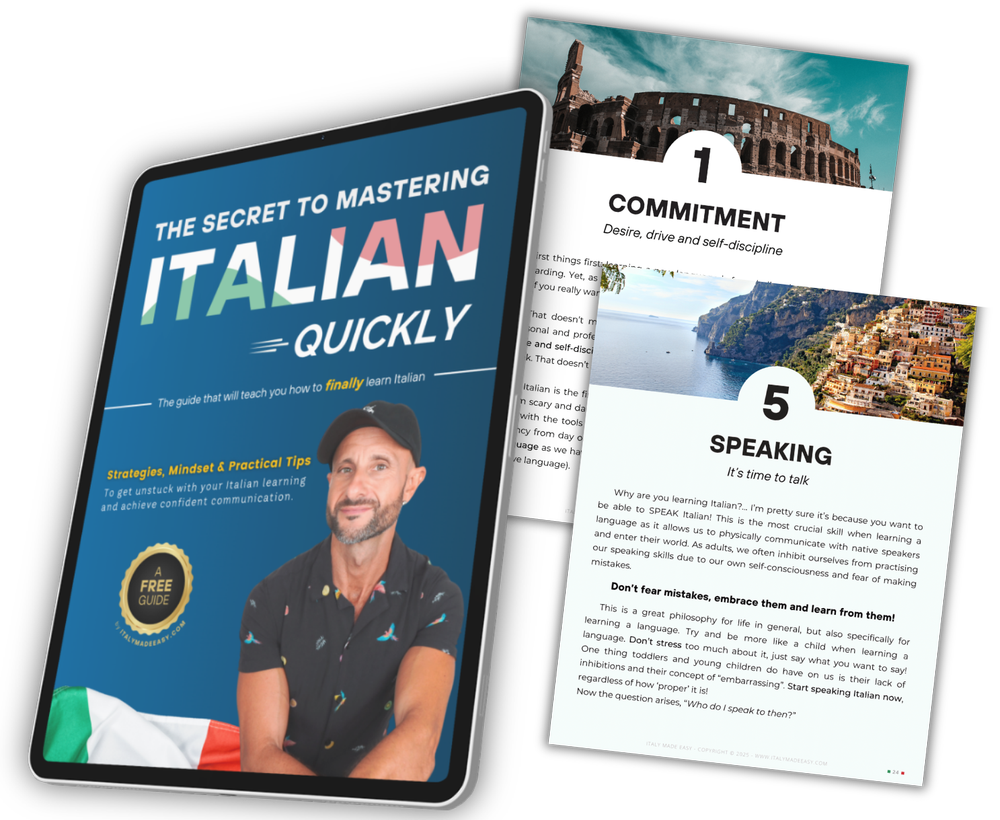
Download the free 39-page guide that reveals what's really holding you back, and the 7-pillar system that finally works.
Get My Free Guide →