
Finding the right path to your Italian fluency
So, you’ve decided to truly commit to Italian. You aren’t just looking for a few phrases; you want to live the language, breathe the culture, and speak with the rhythm of a local. But now you face a crossroads: do you pack your bags for a high-intensity Immersion Course in Italy, or do you enroll in a comprehensive digital roadmap like Italy Made Easy? One promises the “sink or swim” thrill of being surrounded by the language 24/7; the other promises a foolproof, structured foundation you can build from home. But which one fits your life, your budget, and the way your brain actually learns? Let’s break down the trade-offs, and why the “dream” of immersion might have a few hidden traps.
Immersion Courses: The “Deep End” Experience
There is an undeniable romanticism to immersion. The idea is simple: by surrounding yourself with Italian speakers in a classroom in Florence or Rome, your brain will be “forced” to adapt.
The Perks:
- Constant Exposure: You hear Italian at the coffee shop, in the classroom, and on the street.
- Cultural Context: You aren’t just learning words; you are seeing the gestures and smelling the food that goes with them.
- Social Connection: You are often in a group with other students, creating a shared “struggle” that can be highly motivating.
The Reality Check:
The biggest risk with immersion is the “Cognitive Overload“ trap. If you arrive as a beginner, being bombarded with Italian 24/7 can lead to exhaustion rather than learning. Many students find that after four hours of intense “all-Italian” instruction, their brains simply shut down. Without a foundation in your native language (English) to explain why things are happening, you might spend your expensive trip feeling frustrated, confused, and eventually retreating to speak English with your fellow classmates.

Italy Made Easy: The Architectural Approach
Italy Made Easy isn’t just a collection of videos; it’s a structured learning path designed specifically for English speakers. Think of it as building the sturdy frame of a house before you try to move in.
The Perks:
- The “Why” in English: Italy Made Easy explain complex grammar in plain English. This removes the guesswork, saving you months of confusion.
- Sustainable Pace: You don’t have to quit your job or fly across the world. You can study for 20 minutes a day or 5 hours a weekend, whatever fits your actual life.
- Zero-Gap Roadmap: Unlike a 2-week immersion school that might skip around, Italy Made Easy follows a comprehensive learning path from Beginner to Mastery, ensuring your foundation has no holes.
The Reality Check:
While Italy Made Easy provides sophisticated tools for comprehension, it doesn’t provide the “forced” environment of an Italian city. You have to be disciplined enough to create your own “mini-immersion” at home by using our resources and engaging with our community.

Finding Your “Perfect Fit“: Real-World Scenarios
Imagine you have time to devote to your passions, have a generous budget, and want an “experience” as much as a language. You book a month in a Sicilian language school. The warmth of the sun and the daily interactions are magical. However, you might find that while you’ve learned to “survive“, you still don’t understand the grammar. You’re memorizing sounds, but you can’t build your own unique thoughts. You’ve had a great vacation, but your “language engine” is still missing parts. Now, imagine the Busy Professional. You can’t take a month off to live in Siena. You need a path that respects your time. For you, the “Immersion Dream” feels like a distant “someday“. This is where a structured path like Italy Made Easy feels like a relief. It removes the “decision fatigue” of wondering what to study next. It’s the comfort of knowing that the method is there, waiting for you, with a logical progression that ensures you aren’t just mimicking sounds, but actually mastering a skill. Then there is the “Efficiency Expert“. You realize that flying to Italy to spend 4 hours a day in a classroom hearing a teacher explain in Italian is a poor investment of your travel time. You want the “Smart Immersion” strategy: use Italy Made Easy to build your “engine“ at home first. Then, when you finally go to Italy, you aren’t a “student” struggling with basics; you are a “speaker” enjoying the culture.
Practical Scenarios: Which one are you?
“I want an Italian holiday experience and I have a large budget“.
- Go for an Immersion Course. It’s a wonderful way to enjoy the country, provided you accept that your academic progress might be slower than the “experience” suggests.
“I want to reach real fluency without quitting my job or leaving my family”.
- Italy Made Easy provides the reliable, professional foundation you need to reach a high level from your own living room.
“I want to make the most of my future trip to Italy“.
- The Hybrid Approach: Use Italy Made Easy to master the mechanics first. When you arrive in Italy, you’ll be able to actually talk to locals, making your “immersion” 10x more effective.
Frequently Asked Questions
Can I become fluent in just a 2-week immersion course?
Honestly? No. You can gain a lot of confidence and “survival” skills, but 2 weeks isn’t enough time for the brain to internalize complex grammar. Fluency is a marathon, not a sprint.
Is it better to learn “all in Italian” from day one?
For most adults, “pure immersion” is inefficient. Your adult brain wants to understand why a rule exists. Explaining a complex Italian concept in English saves you hours of frustration.
Will Italy Made Easy prepare me for real conversations?
Yes. Because Italy Made Easy teach you the logic of the language, you gain the ability to create your own sentences. We also provide “Comprehension Accelerator” tools to train your ears for native-speed Italian.
How much time should I spend on Italy Made Easy to equal an immersion course?
Consistency is key. 30 minutes of focused study with Italy Made Easy every day is often more effective for long-term retention than a 40-hour “crash course” that you mostly forget two weeks later.
Can I combine the two?
This is the ultimate pro move. Use Italy Made Easy to get through the Beginner levels and the Advanced levels at home. Then, go to an immersion school for a “finishing touch“. You will be the star student because you’ll actually understand what the teacher is saying!
What is the biggest mistake people make with immersion?
Going too early. If you go as a total beginner, you spend most of your time (and money) learning things you could have learned at home for a fraction of the cost. Build your foundation first.
If you want the most effective path to fluency, use Italy Made Easy for your structure and progression, and bring in a tutor to supercharge your speaking skills and get targeted corrections.
Can't speak Italian yet?
It's not you.
It's the method.
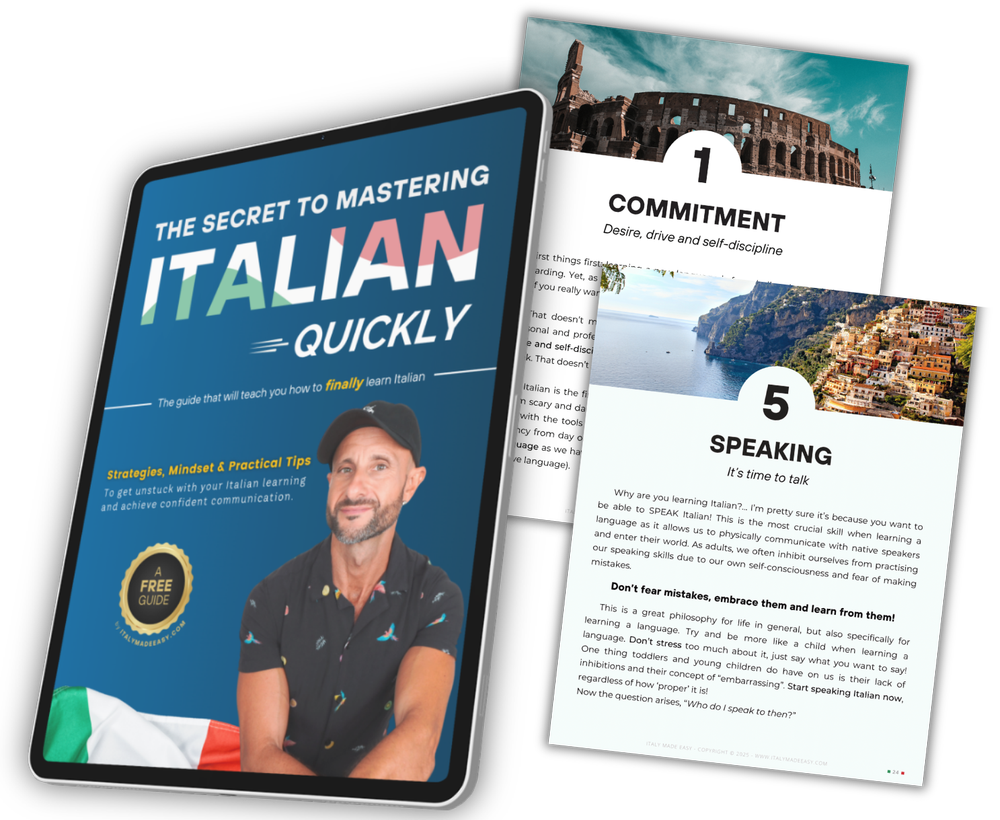
Download the free 39-page guide that reveals what's really holding you back, and the 7-pillar system that finally works.
Get My Free Guide →