
Let’s compare them
So, you’ve decided to learn Italian. You’re dreaming of navigating a Roman square or chatting with locals in a Tuscan vineyard. But now comes the big question: How do you actually get there?
For many, the choice boils down to two heavy hitters: hiring a private 1-on-1 tutor or enrolling in a comprehensive program like Italy Made Easy.
One promises the ultimate personal touch; the other promises a foolproof, structured roadmap. But which one fits your life, your budget, and your brain? Let’s break down the trade-offs of both – and why you might not actually have to choose just one.

Private Lessons: The High-Stakes “Tutor Lottery“
There is no denying it: having a live human being dedicated to your progress is powerful. Private lessons (whether via Zoom or in person) offer immediate feedback that a recorded video simply can’t.
The Perks:
- Real-time Correction: If you mispronounce a word in Italian, a good tutor stops you instantly.
- Pure Speaking Practice: You are forced to produce the language for 60 minutes straight.
- Accountability: It’s harder to skip a lesson when a real person is waiting for you on the other side of the screen.
The Reality Check:
The biggest risk with private lessons is variability. Unless you are hiring a high-level professional teacher (which can be very expensive), many tutors lack a formal plan. You might find yourself in the “Conversation Trap” – spending weeks just chatting about your weekend without actually learning new grammar or expanding your vocabulary. Without a structured path, your progress depends entirely on the “Tutor Lottery“.
Italy Made Easy: The Architectural Approach
Italy Made Easy isn’t just a collection of videos; it’s a structured learning path designed by linguists. Think of it as the foundation and framing of a house.
The Perks:
- Consistent Quality: The method is refined, tested, and logical. It always and consistently guarantees high quality.
- Sustainable Pace: You can study for 15 minutes during lunch or 2 hours on a Sunday. No scheduling headaches or “per-hour” anxiety.
- The “Why” Behind the “What“: Italy Made Easy focuses on how Italian works, specifically for English speakers, so you aren’t just memorizing phrases – you’re building a language engine.
The Reality Check:
While Italy Made Easy provides a structured and comprehensive roadmap to progress from a beginner level to an advanced level, it can not hear you in real time. You have to be disciplinated enough to follow the lessons.

Finding Your “Perfect Fit“: Real-World Scenarios
Imagine you have a trip to Rome on the calendar and a healthy budget to match. You’re the kind of person who wants to jump into the deep end immediately. In this case, hiring a private tutor can feel like a shot of adrenaline. Experiencing the genuine warmth of a native speaker who shares a laugh with you over a mispronounced word or cheers you on when you’re excelling is truly one-of-a-kind.
However, many of us live lives that don’t fit into neat 60-minute blocks every Tuesday at 4:00 PM. Perhaps you’re a busy professional or a parent squeezing in study time while the house is quiet. For you, the “tutor lottery” feels like a risky gamble. You don’t want to log onto a call only to realize your teacher hasn’t prepared a lesson, leaving you stuck in that awkward “so, how was your weekend?” loop for the third week in a row.
You need predictability and a sense of mastery. This is where a structured path like Italy Made Easy feels like a relief. It removes the “decision fatigue” of wondering what to learn next. It’s the comfort of knowing that even if you only have 15 minutes at midnight, the method is there, waiting for you, with a logical progression that ensures you aren’t just memorizing phrases, but actually building a language.
Then there is the “Efficiency Expert” – the learner who hates wasting a single dollar or minute. You might realize that paying an hour for someone to explain a basic grammar rule is, frankly, a poor investment. You want the “Best of Both Worlds“ strategy. You use the structured learning path of Italy Made Easy to build your “engine” in private, mastering the mechanics of the language at your own pace. Then, you bring that engine to a tutor for a “test drive“. This shift transforms the tutor from a teacher into a high-powered coach. Instead of struggling through basics, your sessions become focused, high-level corrections that refine your accent and test your limits. This combination isn’t just about saving money; it’s about the peace of mind that comes from knowing you are in total control of your journey.
Practical Scenarios: Which one are you?
“I have a big budget and I need to speak for a trip in 3 weeks“.
- Go for Private Lessons. You need intensive, 1-on-1 “emergency” prep to get comfortable with basic survival phrases.
“I’m a busy professional with a chaotic schedule”.
- If you want a clear, predictable, and sustainable roadmap that fits into a busy schedule, then Italy Made Easy provides the reliable foundation you need.
“I want the fastest results possible without wasting time or money on repetitive lessons“.
- If you have limited time and want the maximum return on your investment, then the hybrid approach – using Italy Made Easy for structure and a tutor for targeted speaking – is the ultimate pro move.
At a Glance: Comparison Table
Frequently Asked Questions
Is it better to take a course or private lessons to learn Italian?
It depends on your learning style. A structured course like Italy Made Easy provides a logical foundation and a clear roadmap, while private lessons offer immediate, personalized feedback. For most learners, a course is the best way to build the basis, while lessons are a plus.
Are private lessons enough to become conversational?
They are a powerful tool, but lessons alone often aren’t enough. Without a structured plan to follow between sessions, you might find yourself stuck in “random conversations” that don’t push your grammar or vocabulary forward. Real fluency requires consistent study.
How do I choose a good Italian teacher?
Look for a teacher who has a clear plan. Don’t be afraid to ask: “What is your plan for the first ten lessons?” A great tutor shouldn’t just talk to you; they should guide you through a specific progression. If they only offer “free conversation” without a plan, they might not be the best fit for a beginner.
How often should I take private lessons?
For most people, once or twice a week is the sweet spot. This gives you enough time to process what you’ve learned and study independently between sessions. Any more can lead to burnout; any less makes it difficult to maintain momentum.
Are private lessons effective if I don’t study much between sessions?
Honestly? Not really. If you don’t study between lessons, you’ll spend half of your expensive hour just remembering what you did last time. You get the most value from a tutor when you use your time together to apply what you studied on your own during the week.
Will a tutor actually correct my pronunciation and grammar?
Only if you explicitly ask them to! Many tutors are very polite and will let minor mistakes slide to keep the conversation flowing. If you want rigorous correction, tell your tutor: “Please stop me every time I make a mistake so I can fix it immediately”.
Can I combine Italy Made Easy with private lessons?
Absolutely – this is the perfect strategy. Use Italy Made Easy to learn the “how-to” and the logic of the language, then use a tutor once a week to practice speaking.
What is the most cost-effective way to use a tutor without wasting money?
Don’t pay a tutor to explain basic grammar that you can watch in a high-quality video. Use a structured program to learn the rules first, then pay the tutor to help you practice those rules speaking. This ensures every dollar spent on a tutor goes toward active speaking, not passive listening.
Are private lessons better for absolute beginners?
Not necessarily. Many beginners feel overwhelmed by the pressure of a 1-to-1 conversation when they don’t have a foundation yet. Starting with a structured course allows you to build a “safety net” of vocabulary and grammar before you take the leap into live interaction.
What is the fastest approach to speak Italian for work or travel?
The fastest route is the Hybrid Approach. Use the travel-specific modules in a course to get the essentials down, then book 3-5 targeted tutor sessions to role-play the exact scenarios you’ll face – like checking into a hotel or ordering at a restaurant.
If you want the most effective path to fluency, use Italy Made Easy for your structure and progression, and bring in a tutor to supercharge your speaking skills and get targeted corrections.
Can't speak Italian yet?
It's not you.
It's the method.
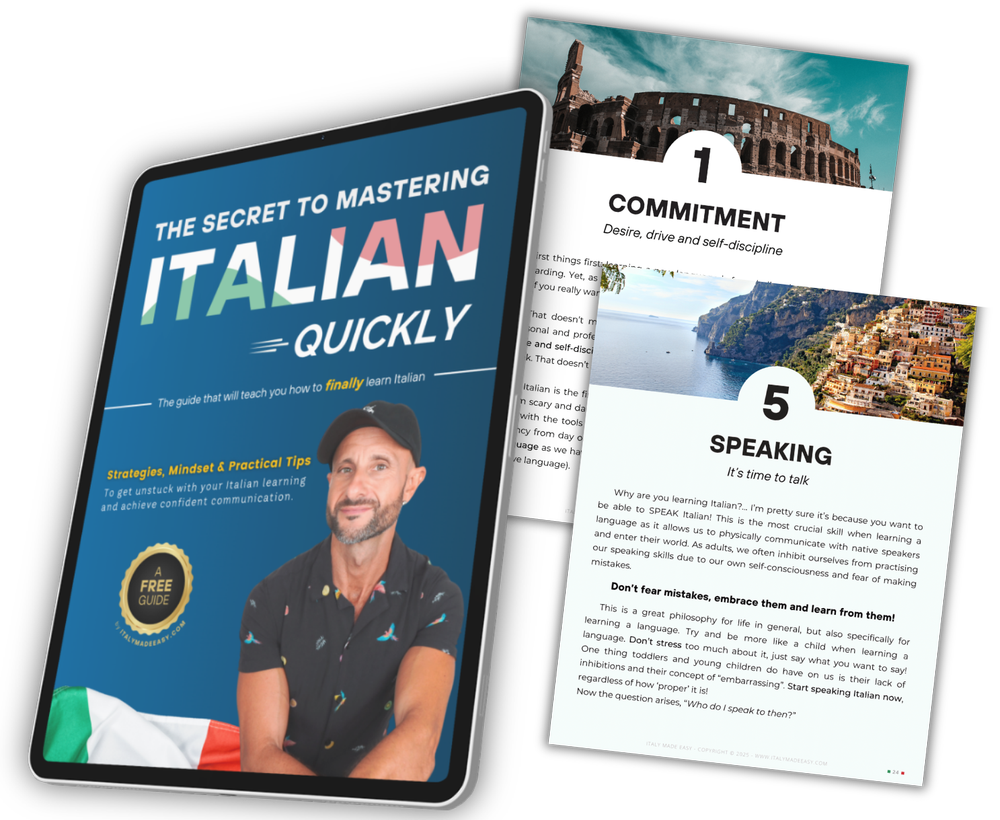
Download the free 39-page guide that reveals what's really holding you back, and the 7-pillar system that finally works.
Get My Free Guide →