
A comparative analysis of both tools
Are you torn between Rosetta Stone and Italy Made Easy to finally start your Italian language journey? With so many apps and courses claiming to be the “fastest” way to fluency, it is often overwhelming to decide which method actually delivers results for a beginner.
Whether you are a professional preparing for a move to Rome or a passionate student aiming for real-life conversations, choosing the right tool is the first step toward success. In this honest comparison, we break down the core differences, learning styles, and pricing of both platforms. By the end of this guide, you will know exactly which one aligns with your goals so you can start speaking Italian with confidence.
Quick Summary
- Choose Rosetta Stone if: You prefer a “no-translation” immersion method where you learn through visual associations and repetitive patterns without grammatical explanations in English.
- Choose Italy Made Easy if: You want a comprehensive, structured path to true fluency that explains how the language works, focuses on real-world conversation, and provides expert guidance.
- The Main Difference: Rosetta Stone relies on a “no-translation” immersion method based on pictures, while Italy Made Easy offers a structured curriculum taught by a native linguist who explains Italian grammar and culture in English.
- Our mini-Verdict: If your goal is to actually speak and understand Italian in complex, real-life situations rather than just matching words to images, Italy Made Easy is the superior choice for serious learners.
At a Glance: Key Differences
To help you decide quickly, here is a high-level comparison between Rosetta Stone and Italy Made Easy. While both aim to teach you Italian, their methods of getting you there are worlds apart.
What this means for you:
- Understanding vs. Guessing: Rosetta Stone asks you to guess the meaning of words through pictures. In contrast, Italy Made Easy explains exactly how Italian works in English, so you never feel lost or frustrated by complex grammar.
- Speaking for Real Life: While Rosetta Stone uses voice recognition to check your pronunciation of single words, Italy Made Easy focuses on building the confidence and structures needed to hold actual conversations with Italians.
- Long-term Progress: Rosetta Stone is great for picking up “travel Italian” or basic nouns, but Italy Made Easy provides a structured, multi-year roadmap that takes you from a complete beginner to a sophisticated, fluent speaker.
Who is Rosetta Stone Ideal For?
Rosetta Stone has been a household name in language learning for decades, and its specific method appeals to a particular type of learner. It is generally a good fit for:
- Visual Learners: Those who enjoy connecting images directly to words and phrases without the intervention of English translations.
- Casual Hobbyists: People who want a low-pressure way to pick up basic Italian vocabulary and common travel phrases during their commute.
- Pattern Seekers: Learners who prefer to “absorb” the language intuitively through repetition rather than studying formal grammar rules.
- Pronunciation Practice: Users who want to use speech-recognition technology to fine-tune the sounds of individual Italian words.
- Short-Term Travelers: Anyone looking for a quick, surface-level introduction to the language before a brief vacation in Italy.
Who is Italy Made Easy Ideal For?
Italy Made Easy is designed for those who don't just want to “swipe” through an app, but actually want to master the Italian language. It is the ideal choice for:
- Goal-Oriented Students: Those who are serious about reaching intermediate or advanced levels of fluency (B1, B2, and beyond).
- All-Ages Learners: People who appreciate having complex Italian grammar explained clearly in English by an expert linguist to avoid confusion.
- Aspiring Expats: Future residents of Italy who need to understand not just the language, but the cultural nuances and social etiquette of daily life.
- Practical Speakers: Learners who want to move past repeating “The apple is red” and start building their own original sentences for real conversations.
- Structure Lovers: Anyone who feels lost without a clear, step-by-step roadmap that takes them from “Buongiorno” to sophisticated storytelling.
- Community Seekers: Students who value being part of an active ecosystem with access to support, feedback, and comprehensive resources.

Function-by-Function Comparison
Content Depth and Levels
- Rosetta Stone: Offers a standardized path across 25 units (approximately levels A1 to B1). The content is repetitive and uses the same images and phrases across dozens of different languages, which can sometimes feel generic.
- Italy Made Easy: Features the “From Zero To Italian” program, a massive, custom-built curriculum that takes you from absolute beginner (A1) to advanced fluency (Advanced and beyond). Every lesson is crafted specifically for the Italian language and its unique quirks.
- What this means for you: While Rosetta Stone helps you “get your feet wet“, Italy Made Easy provides a lifelong roadmap, ensuring you don't hit a “plateau” after learning basic nouns.
Grammar and Explanations
- Rosetta Stone: Operates on a “No-Translation” philosophy. You are never given a grammar rule in English; you must deduce how verbs and gender work by looking at pictures. This “inductive” learning can lead to significant confusion for adult learners.
- Italy Made Easy: Uses “Comparative Linguistics“. Manu explains complex Italian structures in English, drawing parallels to your native tongue. You learn the logic behind the language so you can build your own sentences accurately.
- What this means for you: Understanding the “why” prevents the frustration of guessing. Italy Made Easy empowers you to speak correctly from day one without the guesswork required by Rosetta Stone.
Speaking and Listening Practice
- Rosetta Stone: Relies heavily on TruAccent speech recognition technology. You repeat words into a microphone to match a visual prompt. Listening exercises usually consist of short, isolated sentences tied to photos.
- Italy Made Easy: Focuses on “Real-World Comprehension“. The program includes slow-speed Italian audio, natural conversation strategies, and video lessons that mimic how Italians actually speak.
- What this means for you: You move beyond mechanical repetition. Italy Made Easy prepares your ears for the speed of real Italian life.
Pricing and Value for Money
When comparing costs, it’s important to look beyond the monthly sticker price and evaluate the return on your investment. Are you paying for a digital pastime or a functional skill?
Cost Breakdown
- Rosetta Stone Pricing: Typically operates on a subscription model ranging from $12 to $16 per month, or a one-time “Lifetime” fee of around $199 (often discounted). There is no permanent free version, only a short trial.
- Italy Made Easy Pricing: Operates on a simple membership model — $480/year (less than $10 a week) or $80/month — that unlocks everything: all levels, the Pronunciation program, the Comprehension Accelerator, Immersion, and the private Piazza Italia community. One membership, full access, no upsells.
- The “Cost per Lesson” Reality: With Rosetta Stone, you pay for access to an automated platform. With Italy Made Easy, you are paying for an extensive library of video contentexpert-led video instruction, downloadable workbooks, and a structured curriculum.
- Free Resources: Rosetta Stone offers very limited free content. Italy Made Easy provides a wealth of free high-quality videos, podcasts, and a dedicated “inner circle” community to help you start for free before committing.
Pricing Comparison at a Glance
Learning Experience and Results
Choosing between these two platforms isn't just about price; it’s about how you spend your time and what you can actually do after a month of study.
- A Typical Lesson: In Rosetta Stone, you spend 10–30 minutes matching pictures of people eating or running to Italian phrases. In Italy Made Easy, a typical lesson involves watching a high-quality video where Manu, the founder and the teacher, explains a specific concept, followed by interactive exercises, PDF workbooks, and audio drills to solidify your understanding.
- The Learning Path: Rosetta Stone offers a linear, automated path that feels like a digital textbook. Italy Made Easy provides a comprehensive “From Zero to Italian” roadmap that is highly structured yet adaptable, ensuring you know exactly which step to take next to reach Advanced fluency.
- Speed to Conversation: Because Rosetta Stone avoids English, beginners often spend weeks guessing basic nouns. With Italy Made Easy, you are given the “keys” to the language in English immediately. This means a total beginner can start constructing their own basic, grammatically correct sentences within the first few days.
- Staying Motivated: Rosetta Stone relies on “streaks” and simple progress bars. Italy Made Easy keeps you motivated through engaging, charismatic video content and a massive community of fellow learners who share your journey, making the process feel human rather than robotic.
- Real-World Application: Rosetta Stone is ideal if your goal is to recognize signs at an airport or order a coffee. However, if your goal is to sit at a dinner table with Italians and actually participate in the conversation, Italy Made Easy is the necessary choice because it teaches you how to communicate, not just what words mean.
Pros and Cons
To help you make a final decision, here is a balanced look at the strengths and limitations of both platforms. Transparency is key to choosing the method that fits your lifestyle.
Pros of Rosetta Stone
- Intuitive Interface: The platform is incredibly clean, visual, and easy for anyone to navigate from day one.
- Low-Stress Environment: There are no complex charts or heavy grammar lectures, making it feel approachable for casual learners.
- Speech Recognition: The TruAccent technology provides immediate (though automated) feedback on your pronunciation of individual words.
- Great for Visual Learners: If you learn best by associating images with sounds, this “no-translation” method is highly effective for basic nouns.
- Offline Access: Their mobile app allows you to download lessons, which is perfect for practicing during flights or commutes.
Cons of Rosetta Stone
- Lack of Explanations: Because there is no English instruction, you are often left guessing why a sentence structure changed, which can lead to “learning plateaus“.
- Repetitive Nature: The “see-picture-click-word” cycle can become monotonous over long study sessions.
- Generic Content: Since the same images are used for every language, you miss out on the specific cultural “flavor” and idiomatic expressions unique to Italy.
- Limited Advanced Material: It is difficult to move past a basic conversational level (B1) using only the Rosetta Stone method.
Pros of Italy Made Easy
- Expert-Led Guidance: You are taught by a native linguist (Manu) who explains the “logic” of Italian in English, saving you months of confusion.
- Comprehensive Roadmap: The curriculum is designed to take you from absolute zero to professional-grade fluency (Advanced).
- Real-World Focus: Lessons prioritize how Italians actually speak, including slang, gestures, and cultural nuances you won't find in a standard app.
- Active Support System: You have access to a community of learners and a team of experts to answer your specific questions.
- High-Quality Resources: Beyond video, you get structured PDFs, audio drills, and assignments that turn passive watching into active learning.
Cons of Italy Made Easy
- Requires Commitment: This isn't a “5-minute-a-day” game; it is a professional course that requires mental focus and dedication.
- Higher Initial Investment: While it offers better long-term value, the upfront cost of a full course is higher than a single month of an app subscription.
- Not for “Dabblers“: If you only want to learn five Italian words for a weekend trip, this level of depth might be more than you need.

Frequently Asked Questions
Can I learn Italian from scratch using only Rosetta Stone?
Yes, Rosetta Stone is designed for absolute beginners to pick up basic vocabulary and common phrases through visual immersion. However, because it avoids English explanations, many learners find themselves “stuck” when they encounter complex grammar, often needing a more structured course to reach actual conversation levels.
How long does it take to see real results with Italy Made Easy?
Most students in the From Zero To Italian program report being able to construct their own original sentences within the first week. Because the “why” behind the language is explained in English, you skip the months of guessing typical of immersion apps and can reach a basic conversational level significantly faster.
Can I use both Rosetta Stone and Italy Made Easy together?
Absolutely! Many students use Rosetta Stone as a supplementary tool for quick vocabulary drills or “warm-ups” on their phone, while using Italy Made Easy as their primary “brain” for understanding grammar, structure, and listening comprehension. They can complement each other if you have the time for both.
Which is better if I only have 10 minutes a day?
If you truly only have 10 minutes and want a low-pressure activity, Rosetta Stone's mobile interface is built for quick, bite-sized sessions. However, if you want those 10 minutes to lead to long-term fluency, Italy Made Easy offers concise video lessons and audio tracks that provide deeper progress in the same amount of time.
Does Italy Made Easy offer a certificate of completion?
Yes, as you progress through the structured levels, Italy Made Easy provides milestones and certificates that reflect your move toward mastery.
How to Choose Between Rosetta Stone and Italy Made Easy
Choosing the right platform depends entirely on your personal goals and how you prefer to learn. Here is a quick guide to help you make the final call:
Choose Rosetta Stone if:
- You are a casual learner looking for a low-pressure, visual way to pick up basic Italian nouns.
- You prefer a “no-translation” environment and don't mind guessing grammar rules through picture association.
- You want a simple mobile app to pass the time during a short commute.
Choose Italy Made Easy if:
- You are a serious student, expat, or traveler who wants to reach actual fluency (B1, B2, and beyond).
- You want a native expert to explain the “why” of Italian grammar in English so you can build your own original sentences.
- You value a structured curriculum that covers everything from “Ciao” to complex cultural nuances.
If you are ready to stop “playing” with the language and start speaking Italian naturally and confidently, try Italy Made Easy for freeand experience the difference of a professional-grade education.
Can't speak Italian yet?
It's not you.
It's the method.
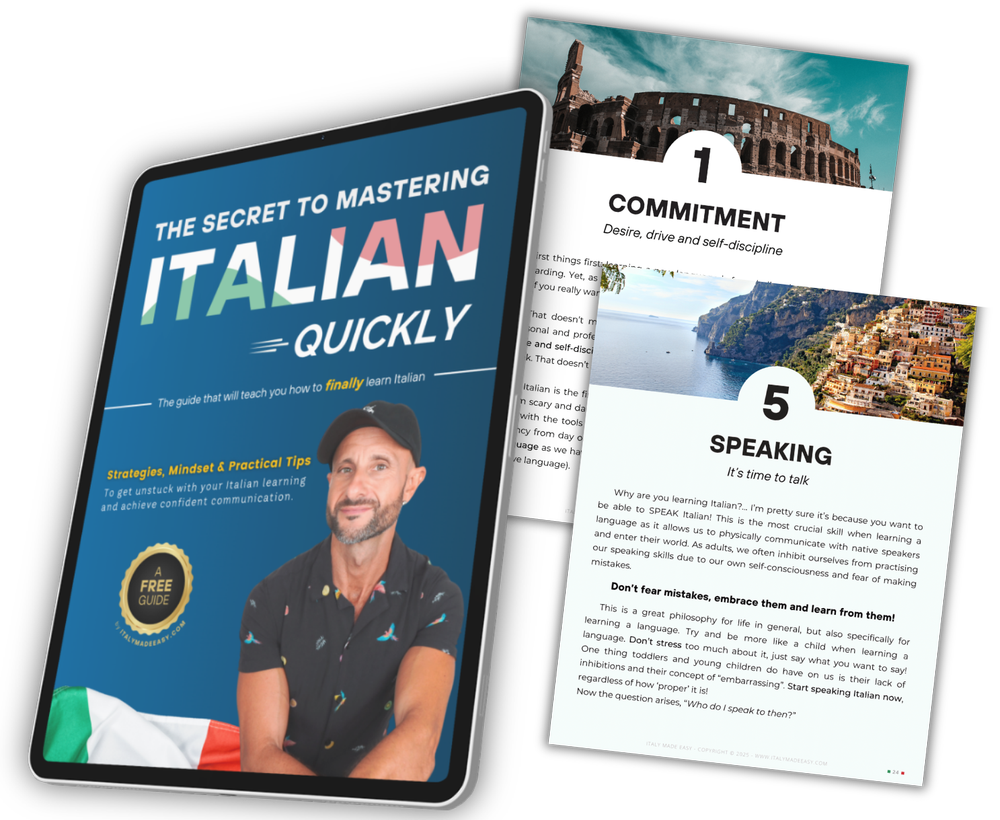
Download the free 39-page guide that reveals what's really holding you back, and the 7-pillar system that finally works.
Get My Free Guide →